How to Buy a House in Menorca: Step-by-Step Legal Process
Step-by-step legal guide to buy a house in Menorca: Nota Simple, arra contract, Balearic ITP taxes, notary completion, and Land Registry steps.
To buy a house in Menorca safely, international and Spanish buyers follow a six-stage legal sequence lasting 6 to 10 weeks from accepted offer to Land Registry inscription: obtaining an NIE tax number, instructing an independent Balearic property lawyer, completing registry and municipal urbanistic checks, signing a 10% contrato de arras deposit agreement, executing the Escritura Pública before a Spanish notary, and paying Balearic Property Transfer Tax (ITP) within 30 working days. On an €850,000 resale villa in Sant Lluís, total transaction costs typically add 10.5% to 12% to the headline price.
Stage 1: Preparation — NIE, Lawyer, and Proof of Funds
Before making a formal offer, prepare your legal and banking infrastructure. Spanish anti-money laundering (AML) regulations require notaries and banks to verify the origin of purchase funds well before completion day.
Obtaining Your NIE Number
Every purchaser must hold a Spanish Número de Identidad de Extranjero (NIE). Non-residents can apply at a Spanish consulate in their home country or grant a notarised power of attorney (poder notarial) to a local lawyer in Menorca to obtain it at the National Police station in Maó via the Spanish National Police NIE portal. Allow 2 to 4 weeks depending on consulate appointment availability. For UK and other non-EU citizens, see our dedicated guide on buying property in Menorca as a non-resident and obtaining an NIE.
Selecting an Independent Lawyer
Never rely solely on a seller’s adviser or an agency’s in-house contact. Hire an independent abogado registered with the Balearic Bar Association (ICAIB) who speaks your language and carries professional indemnity insurance. Typical legal fees for conveyancing in Menorca range from 0.8% to 1% plus 21% IVA, often with a minimum fee around €2,500–€3,500.
Stage 2: Legal Due Diligence Before Any Binding Deposit
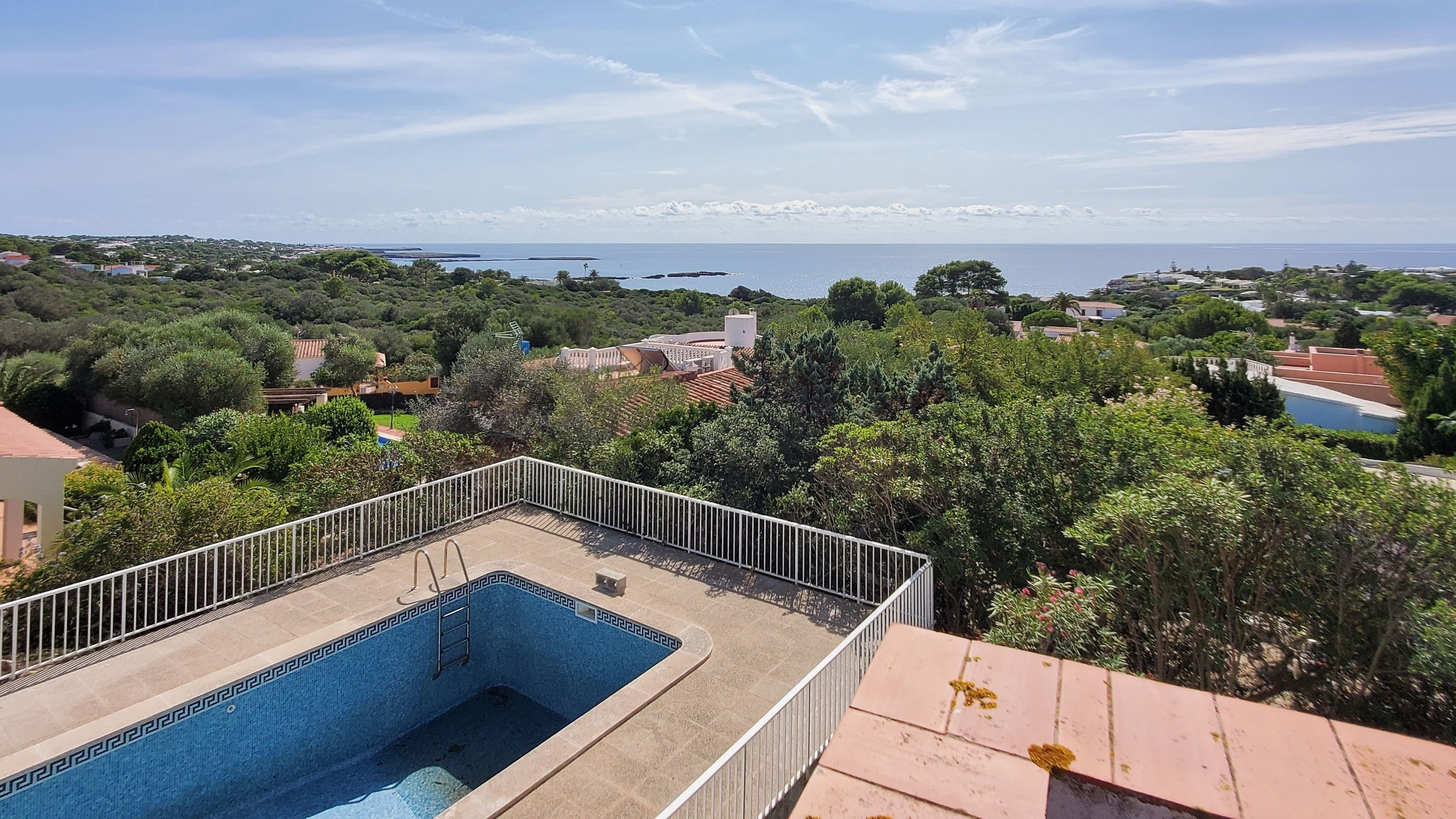
Once an offer is agreed in principle—for instance, on a direct owner listing such as the €850,000 single-storey villa in Cap d’en Font—your lawyer conducts three core checks before you commit a 10% deposit.
Land Registry Check (Nota Simple)
The Nota Simple Informativa confirms:
- Exact legal ownership and how the title is held
- Registered land area (e.g., 876 m²) and built area (e.g., 125 m² house plus 35 m² pool)
- Existing mortgages, liens, embargos, or third-party rights of way
Municipal Urbanistic and Coastal Check
In Menorca, discrepancies between the Catastro (tax cadastre), the Registro de la Propiedad, and physical reality are common on older 1970s homes. Your lawyer verifies with the local town hall—such as the Ajuntament de Sant Lluís—that the property has no open urbanistic infringement proceedings (expediente de infracción urbanística) and, if near the sea (such as 300 metres from Es Caló Blanc), that it sits cleanly outside the public maritime-terrestrial domain (Dominio Público Marítimo-Terrestre under Spain’s Coastal Law).
Mandatory Certificates: Cédula and CEE
The seller must provide a valid Cédula de Habitabilidad (for example, renewed in 2021) and a registered Energy Performance Certificate (Certificado de Eficiencia Energética). Learn why both documents matter for utility transfers and future resale in our Cédula de Habitabilidad guide for Menorca.
| Legal Stage | Typical Timeline | Key Document / Milestone | Typical Buyer Outlay |
|---|---|---|---|
| 1. NIE & Bank Setup | Weeks 1–3 | NIE certificate + Spanish euro account | €100 – €300 (admin/consulate) |
| 2. Legal Due Diligence | Weeks 2–4 | Nota Simple, Catastro, town hall check | Included in legal fee (0.8%–1%) |
| 3. Reservation / Arras | Week 4 | Contrato de Arras Penitenciales | 10% of purchase price |
| 4. Notary Completion | Weeks 8–10 | Escritura Pública de Compraventa | Remaining 90% of price |
| 5. Tax Filing (ITP) | Within 30 working days | Modelo 600 (Balearic ATIB) | Progressive ITP (8%–13%) |
| 6. Registration & Utilities | Weeks 10–16 | Land Registry inscription + IBI/water/power | ~€1,200 – €2,000 (notary + registry) |
Stage 3: Signing the Contrato de Arras
When due diligence is clear, both parties sign a private Contrato de Arras Penitenciales (governed by Article 1454 of the Spanish Civil Code) and the buyer transfers a 10% deposit—€85,000 on an €850,000 purchase—usually to the seller’s account or a lawyer’s escrow account.
Under arras penitenciales:
- If the buyer withdraws without a contractual cause, the buyer forfeits the 10% deposit.
- If the seller withdraws, the seller must return double the deposit to the buyer.
The arras contract specifies the exact completion deadline at the notary, the inventory of any included fixtures, who pays the Plusvalía Municipal (legally the seller’s tax), and a clear representation that all mortgages or debts will be cancelled simultaneously at completion.
Stage 4: Notary Completion (Escritura Pública)
Completion takes place in person—or via your lawyer holding a power of attorney—before a Spanish Notary Public (Notario) in Maó or Ciutadella. The notary reads the Escritura Pública de Compraventa, verifies both parties’ identities and NIE/DNI numbers, confirms the payment trail (typically an OMF Bank of Spain transfer or cheque bancario issued by a Spanish bank), and checks that the latest IBI municipal tax receipt and energy/habitability certificates are attached.
Once signed by buyer, seller, and notary, legal ownership transfers immediately and the keys are handed over.
Non-Resident 3% Retention Rule (When Buying from a Non-Resident Seller)
If the seller is a non-tax-resident in Spain, Spanish law requires the buyer to withhold 3% of the purchase price at completion and pay it directly to the Spanish Tax Agency (Agencia Tributaria) via Modelo 211 within 30 days as an advance against the seller’s capital gains tax. Your lawyer handles this retention automatically on completion day so you never face secondary liability.
Stage 5: Paying Balearic ITP and Registering the Title
Signing at the notary is not the final legal step. Your lawyer or gestor must:
- Settle Balearic ITP: File Modelo 600 with the Balearic Tax Agency (ATIB) within 30 working days of completion. Because the Balearic Islands apply progressive ITP brackets from 8% to 13%, an €850,000 purchase faces a blended effective rate rather than a flat percentage. Check exact figures in our 2026 Menorca property transfer tax (ITP) guide.
- Inscribe at the Land Registry: Submit the stamped Escritura and tax receipt to the Registro de la Propiedad in Maó or Ciutadella. Inscription takes 3 to 6 weeks and makes your ownership enforceable against all third parties.
- Update Catastro and Utilities: Notify the town hall for IBI and waste collection, and transfer electricity (Endesa) and water contracts to your Spanish bank account.
Avoiding Common Pitfalls in Menorca
- Never sign an unvetted agency reservation: Ensure any initial holding deposit is refundable if due diligence uncovers unpermitted extensions or boundary mismatches.
- Check coastal setbacks early: Properties within 100 metres of the shoreline face stricter renovation limits than homes set further back, such as 300 metres inland from Es Caló Blanc.
- Keep all invoices and tax receipts: Every euro paid in ITP, notary, and registry fees reduces your future taxable capital gain if you eventually sell.
For a broader overview of market zones and pricing before you start negotiations, return to our complete Menorca property buyer guide.